其云生物 > > At4g08920(CRY1) ORF Clone
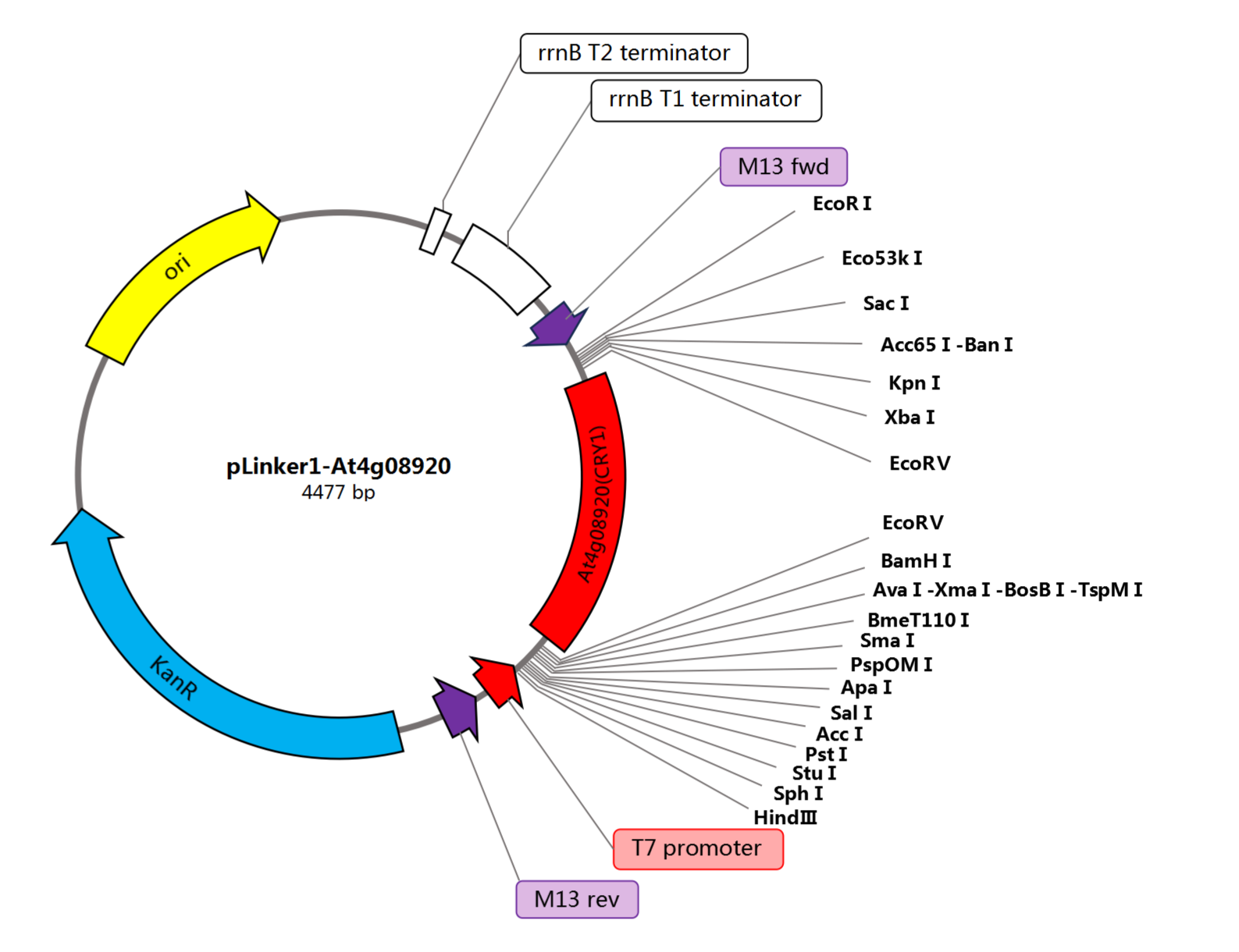
At4g08920(CRY1) ORF Clone克隆是一种重组构建体,其中拟南芥(Arabidopsis thaliana)第4号染色体上的At4g08920基因的开放阅读框(ORF)被插入到克隆载体pLinker1中。该构建体可作为At4g08920基因克隆的多功能工具。此外,通过限制性酶切,可将该基因从载体中切出,并进一步连接到其他表达载体上,用于下游功能研究或蛋白表达分析。
产品编号:QA4g08920
制品内容
pLinker1-At4g08920 2 μg
TE buffer 500 μl
产品说明
本产品是经过离子交换柱纯化后,通过真空干燥获得的2 μg连有At4g08920(CRY1) 基因ORF的质粒DNA干粉,装在无菌冻存管中。
产品信息
产品名称:At4g08920(CRY1) ORF Clone
产品类型:ORF克隆载体
基因ID:At4g08920
转录本:AT4G08920.1
别称:CRY1;BLU1;HY4;At4g08920;T3H13.14;T3H13.5
载体:pLinker1
抗性:kanR
ORF 长度:2046 bp
蛋白长度:681 aa
蛋白分子量:76695 Da
片段物种:拟南芥(Arabidopsis thaliana)
NCBI gene ID:826470
Uniprot ID:Q43125
使用说明
1、以5000 × g离心5 min;
2、小心地打开冻存管,加入20 μL TE buffer溶解DNA,并在室温下孵育10 min;
3、短暂涡旋冻存管,然后瞬时离心(小于5000 × g)。
4、质粒溶液在-20℃下可稳定保存一年,请避免反复冻融。
保存: -20 °C
基因摘要
Encodes CRY1, a flavin-type blue-light photoreceptor with ATP binding and autophosphorylation activity. Functions in perception of blue / green ratio of light. The photoreceptor may be involved in electron transport. Mutant phenotype displays a blue light-dependent inhibition of hypocotyl elongation. Photoreceptor activity requires light-induced homodimerisation of the N-terminal CNT1 domains of CRY1. Involved in blue-light induced stomatal opening. The C-terminal domain of the protein undergoes a light dependent conformational change. Also involved in response to circadian rhythm. Mutants exhibit long hypocotyl under blue light and are out of phase in their response to circadian rhythm. CRY1 is present in the nucleus and cytoplasm. Different subcellular pools of CRY1 have different functions during photomorphogenesis of Arabidopsis seedlings. The mRNA is cell-to-cell mobile.
蛋白简介
Photoreceptor that mediates primarily blue light inhibition of hypocotyl elongation and photoperiodic control of floral initiation, and regulates other light responses, including circadian rhythms, tropic growth, stomata opening, guard cell development, root development, bacterial and viral pathogen responses, abiotic stress responses, cell cycles, programmed cell death, apical dominance, fruit and ovule development, seed dormancy, and magnetoreception. Photoexcited cryptochromes interact with signaling partner proteins to alter gene expression at both transcriptional and post-translational levels and, consequently, regulate the corresponding metabolic and developmental programs (PubMed:21841916). Blue-light absorbing flavoprotein that activates reversible flavin photoreduction via an electron transport chain comprising a tryptophan triad (W-324, W-377 and W-400), accompanied by a large conformational change upon photoexcitation, or via an alternative electron transport that involves small metabolites, including NADPH, NADH, and ATP. The half-life of the activated signaling state is about 5 minutes (PubMed:26313597, PubMed:25157750, PubMed:23398192, PubMed:21875594, PubMed:21467031). Also involved in the detection of blue/green ratio in light (shade under leaf canopies) and subsequent adaptations on plant growth and development (PubMed:20668058). In darkness, the dark reoxidation of flavin occurs and leads to inactivated state (PubMed:21467031, PubMed:23398192). Perceives low blue light (LBL) and responds by directly contacting two bHLH transcription factors, PIF4 and PIF5, at chromatin on E-box variant 5'-CA[CT]GTG-3' to promote their activity and stimulate specific gene expression to adapt global physiology (e.g. hypocotyl elongation and hyponastic growth in low blue light) (PubMed:26724867, PubMed:19558423). When activated by high-intensity blue light, catalyzes direct enzymatic conversion of molecular oxygen O(2) to reactive oxygen species (ROS) and hydrogen peroxide H(2)O(2) in vitro. ROS accumulation upon activation by blue light leads to cell death in protoplasts (PubMed:25728686). Seems essential for blue-light-triggered and singlet oxygen-mediated programmed cell death (PCD) (PubMed:17075038). Required for the induction of nuclear genes encoding photoprotective components by GATA24 and GATA28 in extreme light intensities that exceed the electron utilization capacity of the chloroplast (PubMed:22786870). Involved in shortening the circadian clock period, especially at 27 degrees Celsius, in blue light (BL) and required to maintain clock genes expression rhythm (PubMed:23511208). Mediates blue light-induced gene expression and hypocotyl elongation through the inhibition of COP1-mediated degradation of the transcription factors BIT1 and HY5 and via the activation of anion channels at the plasma membrane, probably via auxin signaling (PubMed:21511872, PubMed:21511871, PubMed:16093319, PubMed:18397371, PubMed:12324610, PubMed:8528277, PubMed:9765547, PubMed:25721730). Required for the hypocotyl hook formation in darkness (PubMed:22855128). Involved in blue light-dependent stomatal opening, CHS gene expression, transpiration, inhibition of stem growth and increase of root growth, probably by regulating abscisic acid (ABA) (PubMed:22147516, PubMed:16093319, PubMed:16703358, PubMed:7756321, PubMed:9565033). Prevents lateral roots growth by inhibiting auxin transport (PubMed:20133010). Necessary for shade avoidance syndrome (SAS), characterized by leaf hyponasty and reduced lamina/petiole ratio, when exposed to blue light attenuation (PubMed:21457375). Together with phototropins, involved in phototropism regulation by various blue light fluence; blue light attenuates phototropism in high fluence rates (100 umol.m-2.s-1) but enhances phototropism in low fluence rates (1.0 umol.m-2.s-1) (PubMed:12857830). Required for blue/UV-A wavelengths-mediated inhibition of explants shoot regeneration in vitro (e.g. new shoot apical meristems regeneration from excised cotyledons) (PubMed:22681544). Modulates anthocyanin accumulation in a PHYA-dependent manner in far-red-light. Acts as a PHYA/PHYB-dependent modulator of chlorophyll accumulation in red light. Contributes to most blue light deetiolation responses (PubMed:9733523, PubMed:8528277). May act as a chemical magnetoreceptor, via magnetically sensitive kinetics and quantum yields of photo-induced flavin / tryptophan radical pairs (PubMed:22421133). The effect of near-null magnetic field on flowering is altered by changes of blue light cycle and intensity in a CRY1/CRY2-dependent manner (PubMed:26095447). Involved in the strigolactone signaling that regulates hypocotyl growth in response to blue light (PubMed:24126495). Modulates temperature-dependent growth and physiology maintenance, especially at warm ambient temperatures, via HFR1-dependent activity (PubMed:21265897). {ECO:0000269|PubMed:12324610, ECO:0000269|PubMed:12857830, ECO:0000269|PubMed:16093319, ECO:0000269|PubMed:16703358, ECO:0000269|PubMed:17075038, ECO:0000269|PubMed:18397371, ECO:0000269|PubMed:19558423, ECO:0000269|PubMed:20133010, ECO:0000269|PubMed:20668058, ECO:0000269|PubMed:21265897, ECO:0000269|PubMed:21457375, ECO:0000269|PubMed:21467031, ECO:0000269|PubMed:21511871, ECO:0000269|PubMed:21511872, ECO:0000269|PubMed:21875594, ECO:0000269|PubMed:22147516, ECO:0000269|PubMed:22421133, ECO:0000269|PubMed:22681544, ECO:0000269|PubMed:22786870, ECO:0000269|PubMed:22855128, ECO:0000269|PubMed:23398192, ECO:0000269|PubMed:23511208, ECO:0000269|PubMed:24126495, ECO:0000269|PubMed:25157750, ECO:0000269|PubMed:25721730, ECO:0000269|PubMed:25728686, ECO:0000269|PubMed:26095447, ECO:0000269|PubMed:26313597, ECO:0000269|PubMed:26724867, ECO:0000269|PubMed:7756321, ECO:0000269|PubMed:8528277, ECO:0000269|PubMed:9565033, ECO:0000269|PubMed:9733523, ECO:0000269|PubMed:9765547, ECO:0000303|PubMed:21841916}.; Implicated in promoting R protein-mediated resistance to Pseudomonas syringae pv. tomato (Pst.) DC3000 under continuous light conditions. Promotes systemic acquired resistance (SAR) and PR gene expression triggered by P. syringae. {ECO:0000269|PubMed:20053798}.
关键词
3D-structure;Apoptosis;ATP-binding;Chromophore;Cytoplasm;Disulfide bond;FAD;Flavoprotein;Magnesium;Metal-binding;Nucleotide-binding;Nucleus;Phosphoprotein;Photoreceptor protein;Plant defense;Receptor;Reference proteome;Sensory transduction
扩增方案
1、收到质粒干粉后请先5000 rpm离心1 min,再加入20 μL TE buffer溶解质粒,室温放置1 min;
2、从-80 °C冰箱中取出相应的感受态,置于冰盒上解冻,并做好标记;
3、取2 μL质粒加至100 μL感受态中,冰浴30 min;
4、42 °C热激90 s,再冰浴2 min;
5、加入900 μL无抗的LB液体培养基,200 rpm震荡培养45 min;
6、5000 rpm离心5 min,仅留100 μL上清混匀菌体沉淀;
7、混匀后的菌液加至对应抗性的LB平板上,倒入适量玻璃珠,涂匀液体;
8、将平板正向培养1 h,再倒置培养12 h~16 h;
9、挑取单克隆菌落至对应抗性的LB液体培养基中,震荡培养12 h~16 h,根据实验需要提取质粒。
注意事项
1、同一个基因的单个转录序列可能由于自然变异 (如单核苷酸多态性)而有所不同,每一种都有其自身有效的存在。
2、该克隆被工程化,但表达取决于基因的性质。
3、本产品仅限于科学研究,不得用于临床诊断或治疗,不得用于食品或药品。
4、为了您的安全和健康,请穿实验服并戴一次性手套操作。
相关文献 (NCBI PubMed ID)
PMID: 8232555; 10617198; 27862469; 14593172; 12324610; 7756321; 8528277; 8953250; 9565033; 9651577; 9733523; 9765547; 11114337; 11260718; 11509693; 11752373; 11743105; 12846824; 14523249; 12857830; 16093319; 15751956; 15805487; 15610358; 17073458; 16703358; 17075038; 18065688; 18003924; 18397371; 19327354; 19558423; 21841916; 20705178; 20133010; 20053798; 20668058; 20926618; 21511872; 21511871; 21467031; 21875594; 21265897; 21457375; 22890584; 22577138; 21765176; 22786870; 22855128; 22147516; 22421133; 23511208; 22681544; 23398192; 25157750; 24126495; 26095447; 26596765; 25721730; 25728686; 26313597; 26724867; 15299148
质粒图谱
更多详细信息请见其云官网(www.qiyunbio.com)
| 参数名称 | 参数值 |
|---|---|
| 保质期 | 3个月 |
| 储存 | |
| 产品内容 | 拟南芥基因 |
| 产品用途 | 基因克隆 |
| 货期 | 2-3周 |
| 载体 | pLinker1 |
| 载体类型 | 克隆载体 |
| 菌株类型 |